Explainer · Nutrition & Diet
How much water do people need each day? What the research shows
The eight-glasses-a-day rule is widely repeated but has little evidence behind it. Measurements in 5,604 people show water needs vary widely with body size, activity and climate, and food supplies part of the total.
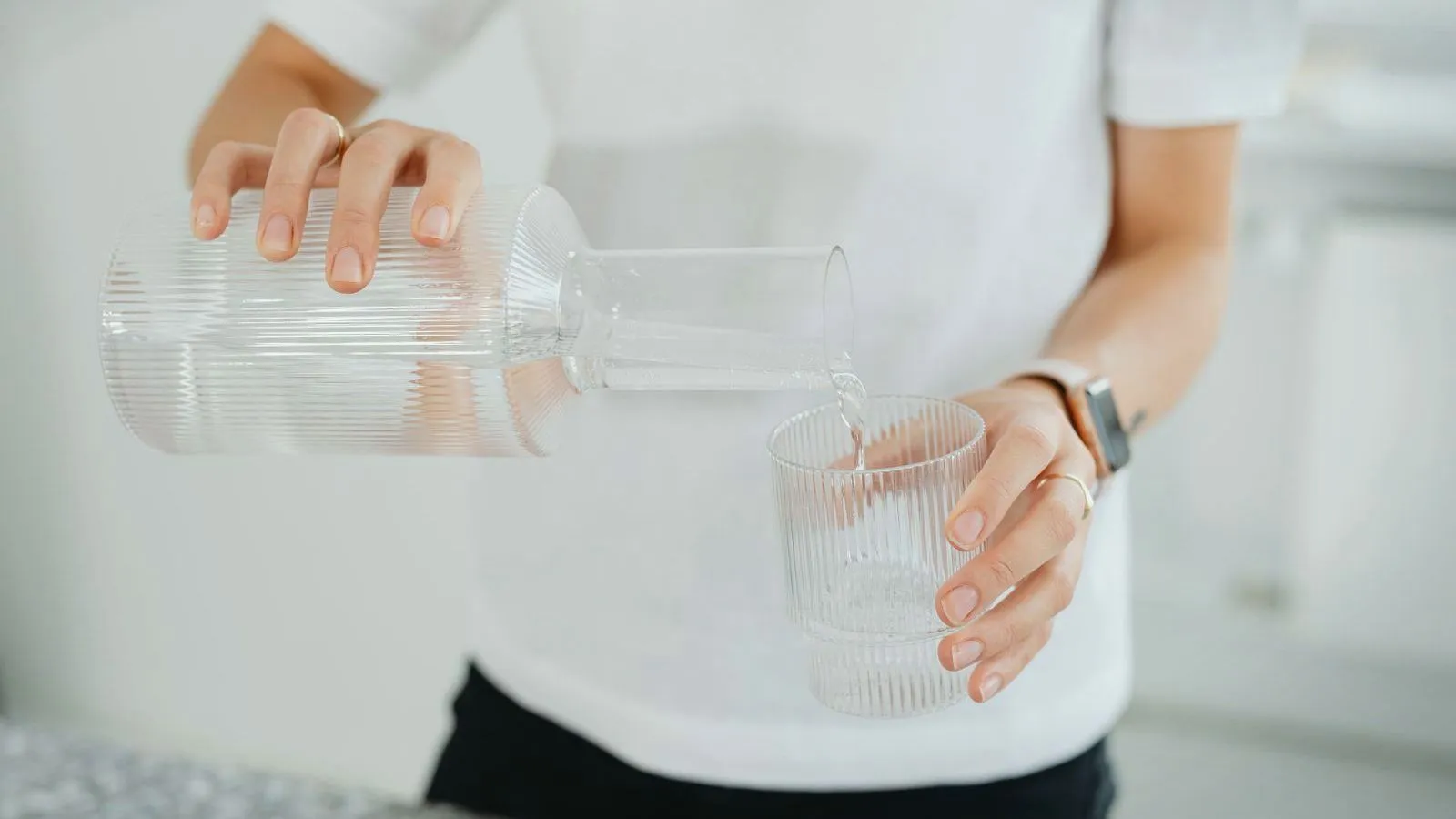
- A 2002 review found no scientific studies supporting the advice to drink eight 8-ounce glasses of water a day.
- A study in Science measured daily water use in 5,604 people aged 8 days to 96 years in 23 countries.
- Body size, physical activity, pregnancy, climate and altitude all changed how much water people used.
- US reference intakes, 3.7 liters a day for young men and 2.7 for young women, count water from food and all drinks.
- The National Academies say thirst and drinks at meals keep most healthy people hydrated day to day.
“Drink eight glasses of water a day” is one of the most repeated pieces of health advice. It sounds precise, but the number has never had much evidence behind it, and it leaves out where most people’s water actually comes from.
Research that measures how much water bodies use shows that needs vary widely from person to person, with body size, activity, pregnancy and climate all playing a part. Official reference values count water from food and all drinks, not only plain water, and they are averages rather than personal targets.
Where the eight glasses of water rule came from
In 2002, in the American Journal of Physiology, the physiologist Heinz Valtin set out to find the origin of the advice to drink at least eight 8-ounce glasses a day, known as “8 x 8”, and to examine the evidence for it. After searching the literature and consulting nutritionists who specialize in thirst and drinking, he reported that no scientific studies were found in support of the rule.
Surveys of food and fluid intake in thousands of healthy adults suggested such large amounts were not needed. He also noted that caffeinated drinks may indeed be counted toward the daily total, contrary to a common claim that they do not count. His conclusion was limited to healthy adults in a temperate climate who were not very active. Larger intakes, he wrote, are called for in special circumstances such as vigorous work and exercise, especially in hot climates.
How much water the body actually uses
A study published in Science in 2022 measured water turnover, the water used by the body each day, in 5,604 people from 8 days to 96 years old in 23 countries. It used isotope tracking, a method that follows a harmless labeled form of water through the body to measure how much is taken in and lost.
Water use varied widely. Age, body size and body composition were all linked to how much water people turned over, as were physical activity, athletic training and pregnancy. So were the surroundings: latitude, altitude, air temperature and humidity. People in countries with a low human development index, a measure of income, education and life expectancy, had higher water turnover than people in wealthier countries.
The researchers used the data to build equations that predict water turnover from factors such as body size, activity and climate. Water turnover is not the same as how much people need to drink, because some water comes from food and some is made by the body itself.
What official water intake values say
The US reference values come from the Dietary Reference Intakes set in 2005 by the Institute of Medicine, now part of the National Academies. They use an adequate intake (AI), an amount based on what healthy people typically consume rather than a tested requirement. In the report’s words, the AI for total water intake for young men and women (ages 19 to 30 years) is 3.7 L and 2.7 L per day, respectively, counting water from food and drinks together.
The report is explicit that these are not targets for plain water. On a day-to-day basis, it says, fluid intake, driven by the combination of thirst and the consumption of beverages at meals, keeps healthy people’s hydration at normal levels. Needs rise with heat and physical activity.
In Europe, the European Food Safety Authority set adequate intakes of total water of 2.0 liters a day for women and 2.5 liters for men. Its reference values include water from drinking water, beverages of all kind, and from food moisture, and apply to moderate temperatures and moderate activity. The authority adds about 300 mL a day in pregnancy and about 700 mL a day while breastfeeding.
How food and other drinks count toward daily water
A large share of daily water does not come from glasses of water. National survey data in the US report suggest that approximately 20 percent of water comes from food, with the rest from drinks of every kind, and the body also makes a little water as it burns food for energy.
That includes drinks often said not to count. The 2002 review found that caffeinated drinks and, to a lesser extent, mild alcoholic beverages like beer in moderation may be counted toward the daily total, although heavy drinking is a different matter.
When water needs go up
The Science study shows which situations push water use higher: physical activity, athletic training, pregnancy, heat, humidity and altitude. The 2002 review makes the same point from the other direction, noting that large intakes suit hard physical work and exercise in hot climates, and the treatment or prevention of some diseases.
Too little water carries its own risk. A 2010 review in Nutrition Reviews describes water as a critical nutrient, the absence of which will be lethal within days. The same review points out how little long-term evidence there is on everyday intake: there are no published randomized, controlled longer-term trials of water intake and health.
Observational studies offer hints. In a 2023 study in BMC Medicine of older Spanish adults with metabolic syndrome, more than half were physiologically dehydrated on a blood test, even though most met European intake targets. Lower physiological hydration status was associated with a greater decline in global cognitive function over two years, while the amount of water people reported drinking was not. Hydration measured in the blood, it seems, is not the same thing as how much people think they drink.
What the water research cannot tell us
Water turnover measures how much water bodies use, not the ideal amount for health. The studies here do not show whether drinking more water than thirst prompts improves long-term health, or by how much. The reference values are population averages based largely on what healthy people already consume, not targets tested in trials.
Individual needs also shift from day to day with weather, activity and illness, which no single number can capture.
What the water evidence adds up to
The eight-glasses rule has little scientific support, and water needs vary widely between people and situations. Reference values of roughly 2 to 3.7 liters a day refer to total water from food and all drinks, not plain water alone.
For healthy adults in moderate conditions, the sources here describe thirst and drinks with meals as generally enough, with needs rising in heat, exercise, pregnancy and breastfeeding. How much a particular person needs depends on their body, activity, surroundings and health.
People also ask
Is there evidence for drinking eight glasses of water a day?
A 2002 review found no scientific studies supporting the rule of eight 8-ounce glasses a day. Its conclusion applied to healthy adults in a temperate climate who were not very active.
How much water does the US reference intake suggest?
The US adequate intake of total water is 3.7 liters a day for young men and 2.7 liters for young women, counting water from all foods and beverages. About 20% of it typically comes from food.
What are the European water intake values?
The European Food Safety Authority set adequate intakes of total water of 2.0 liters a day for women and 2.5 liters for men, including water in food, for moderate temperatures and activity levels. It adds about 300 mL a day in pregnancy and about 700 mL while breastfeeding.
Does coffee count toward water intake?
A 2002 review found that caffeinated drinks may be counted toward the daily total, and the European Food Safety Authority counts beverages of all kinds toward total water intake.
What affects how much water a person uses?
In the study of 5,604 people, age, body size and composition, physical activity, athletic status, pregnancy, socioeconomic status, latitude, altitude, air temperature and humidity were all associated with water turnover. This is general information rather than medical advice.
References
- Yamada, Y., Zhang, X., Henderson, M. E. T., et al. Variation in human water turnover associated with environmental and lifestyle factors. Science, 2022.
- Valtin, H. Drink at least eight glasses of water a day. Really? Is there scientific evidence for 8 x 8? American Journal of Physiology-Regulatory, Integrative and Comparative Physiology, 2002.
- EFSA Panel on Dietetic Products, Nutrition, and Allergies. Scientific Opinion on Dietary Reference Values for water. EFSA Journal, 2010.
- Institute of Medicine. Dietary Reference Intakes for Water, Potassium, Sodium, Chloride, and Sulfate. Chapter 4: Water. National Academies Press, 2005.
- Popkin, B. M., D'Anci, K. E., Rosenberg, I. H. Water, hydration, and health. Nutrition Reviews, 2010.
- Nishi, S. K., Babio, N., Paz-Graniel, I., et al. Water intake, hydration status and 2-year changes in cognitive performance: a prospective cohort study. BMC Medicine, 2023.